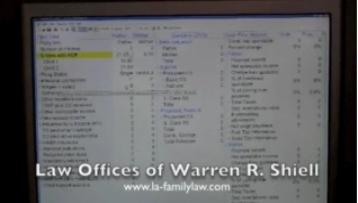
| Child Support and Divorce Lawyer in Los Angeles CHILD SUPPORT IN CALIFORNIA Child Support Overview In 1999, over $14 billion was owed to California's children. 35% of single parent families had income below the poverty line. Statistics show that payment of child support reduces poverty and corresponds to greater involvement by the non-custodial parent in the children's lives. Do I have to pay child support? Child Support must be paid by a non-custodial parent until the child marries, dies, is emancipated, turns 18 and is not a full time high school student, or turns 19 if they are a full time high school student, whichever occurs first. An adult child who is disabled and unable to earn a living has an ongoing right to support. How much child support should I pay or receive? In California, the courts use a complex mathematical formula to calculate child support that is based on a number of factors such as the gross income of each parent, the percentage of time each parent spends with each child, available tax deductions, child care costs, tax status of each parent and so on. This amount is often referred to as the "guideline" child support amount. Because of the complexity of calculating the "guideline" amount, the Court uses a software program called "Dissomaster." Most attorneys use this program and will be able to perform child support calculations. The Dissomaster software can be found at https://cflr-dissomaster1.software.informer.com/4.1/. Any child support order must specify the amount of child support and when it is to be paid. Couples often agree to monthly payments in two installments to coincide with the payor's bi-weekly receipt of wages. View calculation of child support video demo using Dissomaster Do the courts ever deviate from the standard formula for child support? The Court may depart from the "guideline" amount in a number of situations set forth in Family Code section 4057 (b). For example, the parent ordered to pay child support may have extraordinary high income and the guideline amount would exceed the needs of the children. Another example would be where the children have special medical or other needs that require an amount greater than the guideline. Can I get my spouse to pay extra for child care and training expenses? There are a number of additional expenses that the non-custodial parent may be required to pay in full or in part. Mandatory add-ons that the Court is required to order include child care costs related to a parent's employment or training or education for employment and the reasonable uninsured health care costs for the children. Discretionary add-ons include costs related to educational or other special needs of the children and travel expenses for visitation. Generally, the Court will allocate add-ons equally between the parties. However, if the paying parent can prove that this would be unfair, Family Code section 4061(b) provides a procedure for the Court to allocate the payment of add-ons according to the net spendable income of each party. This most often comes into play where one party is also paying spousal support. Who pays for health insurance for the kids? Family Code section 3751 requires the Court, when making a child support order, to order either or both parents to maintain health insurance for the minor children if it is available at no cost or at a reasonable cost. How do I get child support order? Once a petition in a dissolution (divorce) has been filed a parent may request that the Court order temporary child support for children born during the marriage. Where the parents are not married, before the Court can order support, paternity must be established. Since January 1, 1995, all hospitals have been required to provide unmarried parents with the opportunity to voluntarily acknowledge paternity by signing a Voluntary Declaration of Paternity. If this is signed and not rescinded within 60 days it has the same effect as a paternity judgment and can provide the basis for custody, visitation or support. Even if it has not been challenged a motion for genetic testing may still be brought within two years of the child's birth challenging the Voluntary Declaration of Paternity. Once I've gotten a child support order how do I enforce it? In California, every time the Court makes a child support Order it must issue a Wage Assignment Order that directs the payor's employer to deduct the amount of child support from wages and pay it directly to the payee parent. The wage assignment can be stayed by written agreement of the parties. Can I get help from the County to collect child support? Parents can retain a private attorney to establish and collect support or employ the services of the Department of Child Support Services (DCSS). Unfortunately, Los Angeles County has one of the poorest child collection records in the state and fares poorly when compared to national statistics. What other action can I take to collect child support? If you are owed child support arrears you may request that Court hold the payor parent in contempt. If you can prove that non-payment was knowing and willful, the payor parent can be fined and even jailed. If you are owed child support arrears you may bring an Order To Show Cause requesting that the Court determine the amount of arrearages. You can also petition the Court for a Writ of Execution which can be used against bank accounts. Family Code section 4600 also allows the Court to order the payor parent to deposit up to one year's child support payments in an interest bearing account as security. This can be used if there's been a problem receiving child support in the past or if the payor is self employed. Can I modify a child support order if circumstances change? If you already have a judgment in your case you can find out if the payor's income has changed by having them served with a Request for Production of an Declaration After Judgment (form FL-396) on the other parent, along with an Income and Expense Declaration (form FL-150) which are available from https://www.courts.ca.gov/forms.htm What are the tax consequences of paying or receiving child support? Child support is not taxable income to the parent who receives it and it cannot be deducted by the parent who pays it. Contact a Los Angeles Divorce Attorney at Law Offices of Warren R. Shiell to discuss your child support issue. Call for a free consultation now 310.247.9913. ADDITIONAL RESOURCES
return to top of page < HOME © 2020 Warren R. Shiell. All rights reserved. Los Angeles Divorce and Family Law Attorney. The information contained in this website is an "Advertisement." It is for informational purposes only and shall not constitute legal advice. Nothing in this Website shall be deemed to create an Attorney-Client relationship. An Attorney-Client relationship shall only be created when this office agrees to represent a Client and a Client signs a written retainer agreement. |


PRACTICE AREAS
Prenuptial Agreements
Domestic Violence
Taxes
Prenuptial Agreements
Domestic Violence
Taxes
Family law attorneys at Law Offices of Warren R. Shiell represent clients in Beverly Hills, Los Angeles, Brentwood, West Hollywood, Culver City, Glendale, Pasadena, Santa Monica,
Van Nuys, Sherman Oaks, Calabasas, Burbank, Pacific Palisades, Malibu, other areas around Los Angeles and Southern California. We also represent clients from out of state and
different countries Europe, Americas and Australia among others on California divorce and family law matters. Site Map
Van Nuys, Sherman Oaks, Calabasas, Burbank, Pacific Palisades, Malibu, other areas around Los Angeles and Southern California. We also represent clients from out of state and
different countries Europe, Americas and Australia among others on California divorce and family law matters. Site Map
 |
| |
 |
| |
 |
| |
 |
| |
 |
| |
 |
| |
 |
| |
 |
| |
 |
| |
 |
| |
 |
| |
| |
| |
 |
| |
 |
| |
 |
| |
 |
| |
 |
| |
 |
| |
 |
| |
| |
 |
| |
 |

| PRACTICE AREAS |

| RESOURCES |